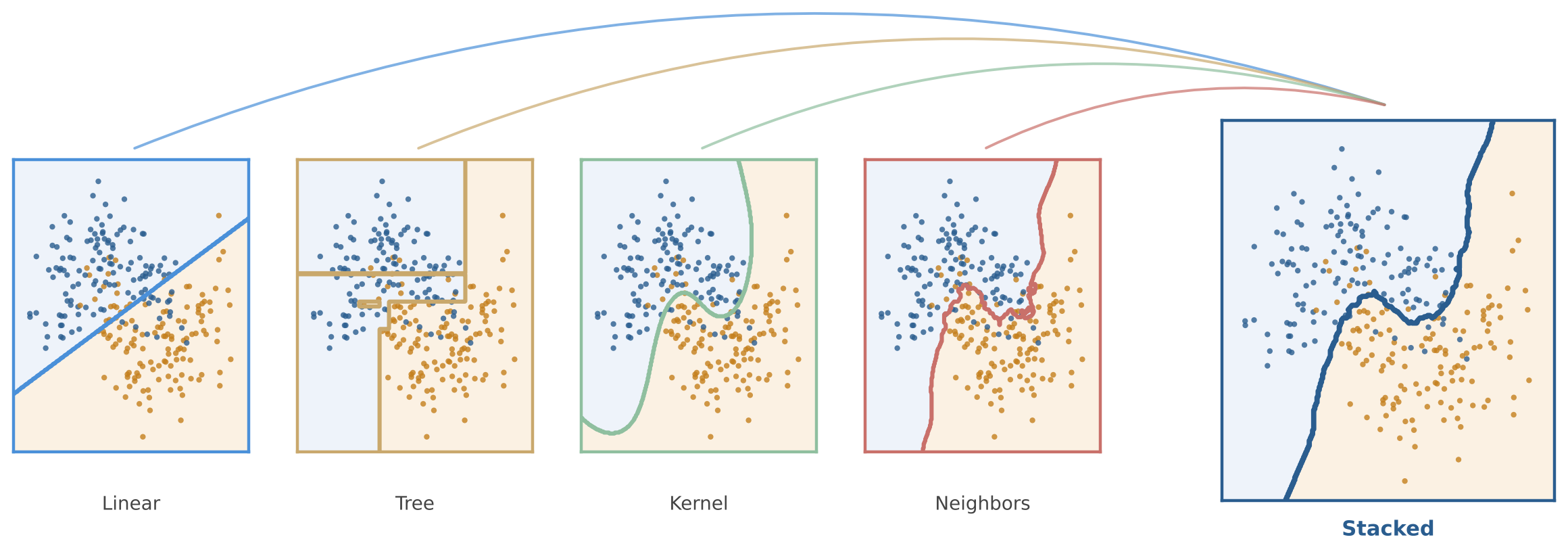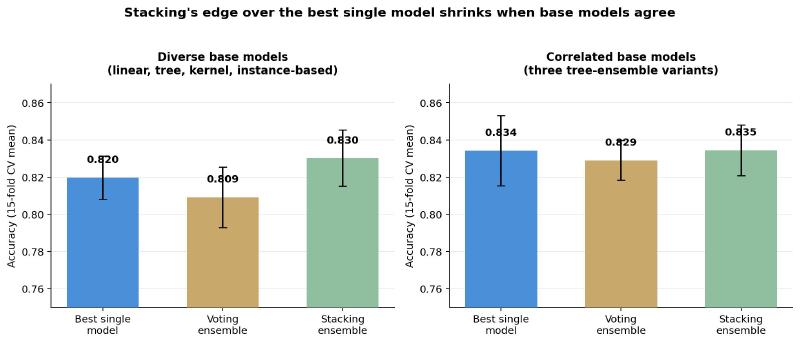
🤖 Does combining several models always improve results? No. In the author’s experiment, stacking—a model that learns to combine other models’ predictions—slightly beat the best individual model when the models made different errors. When the models were very similar, the improvement nearly vanished while training costs increased.
Simple voting did not guarantee better results either: it averages predictions without learning which model is more reliable. Stacking, by contrast, uses an additional model to adjust how much to trust each one.
The author tested both scenarios on a synthetic dataset with repeated cross-validation. The numbers do not prove the same result will hold for every problem; they do illustrate an important condition: diversity in errors can make a difference.
💡 Explanation in a nutshell#
Imagine asking several people for their opinions. If they all repeat the same mistake, combining their answers will not help much. If each model brings a different perspective, a combiner can learn to give more weight to the reliable answers. Before stacking models, measure that diversity and compare any improvement with its cost.
More information at the link 👇