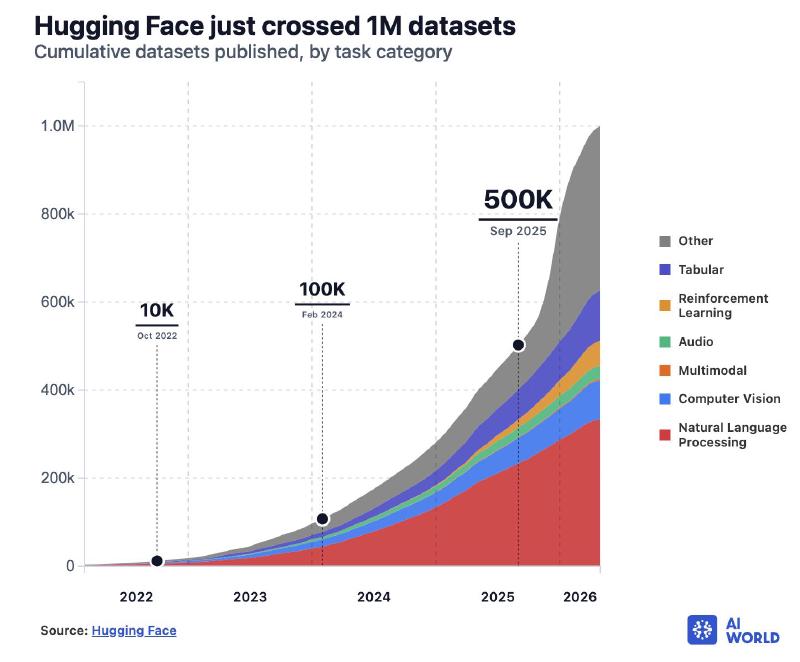
🌍 The open-model ecosystem is growing rapidly. Hugging Face’s analysis, based on data from January through August 2026, shows millions of models, datasets, and Spaces being published, but with a very uneven distribution: a small number of repositories account for almost all downloads.
🚀 The performance frontier moved quickly, especially as Chinese labs released enormous models. However, attention does not equal adoption: the most discussed models are not necessarily the ones used most in production.
🧩 Qwen became a community foundation. Its models produced more than 151,000 derivatives because they offer a broad family, consistent updates, and permissive licenses. The community builds conversions, fine-tunes, and variants on top of them.
📱 Small models remain the practical layer: they run on the hardware developers actually have and receive most downloads. At the same time, agents are becoming direct model users, changing what it means to optimize an AI experience.
💡 Explanation in a nutshell#
A flashy model may receive many likes, while a small, stable model may be integrated into thousands of applications. Understanding the AI market requires watching both novelty and sustained use, as well as the ecosystem built around each model.
More information at the link 👇