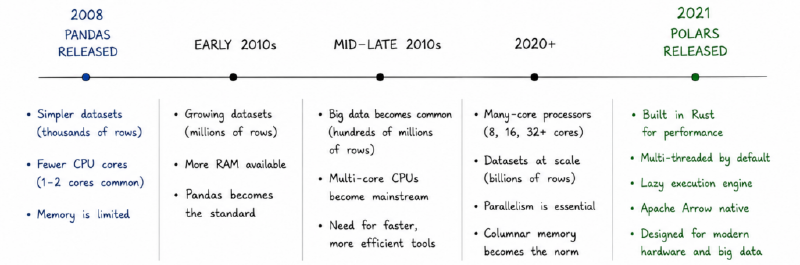
Pandas has been the standard for cleaning, exploring, and preparing data for more than a decade. Polars is an alternative designed for modern hardware: it uses multiple cores, lazy execution, and Apache Arrow’s columnar format. ⚡
That is why it is often faster, especially with large volumes and complex transformations. Lazy execution builds and optimizes a plan before materializing it, avoiding unnecessary work and reducing memory movement.
💡 Explanation in a nutshell#
Pandas normally executes each operation immediately and is convenient for notebooks, learning, and small datasets. Polars has a similar syntax but behaves like a planner: it gathers operations, optimizes them, and distributes work across cores when useful.
There is no absolute winner. Pandas has a huge ecosystem and broad compatibility with visualization and machine learning. Polars shines when size, complexity, or preprocessing time becomes a bottleneck. Both can coexist: explore with Pandas and ship with Polars.
More information at the link 👇