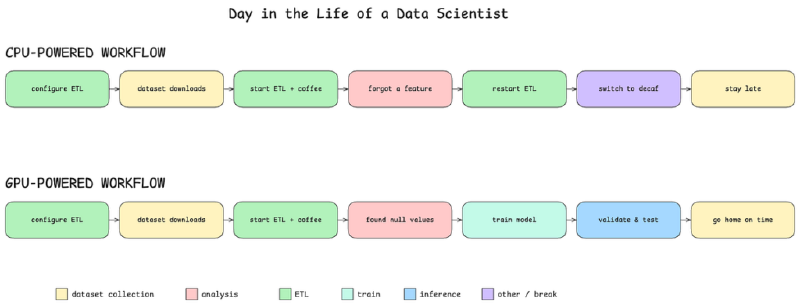
⚡ Many data science tasks work with tables and still run on the CPU. As datasets grow, filtering, joins, groupby aggregations, and sorting can become bottlenecks.
The RAPIDS ecosystem makes it possible to move these workflows to the GPU with small changes. cuDF provides a pandas-like API for DataFrames whose operations run on the graphics card. For existing pandas code, cudf.pandas tries to execute each operation on the GPU and automatically falls back to the CPU when something is unsupported.
Polars can also use a cuDF-based GPU engine. Its Lazy API builds an optimized plan and decides whether to run it on the GPU or CPU; it can even distribute work across multiple GPUs with Ray.
🚦 Not everything gets faster on a GPU. With small datasets, data-transfer overhead can outweigh the benefit. Custom Python functions can also trigger CPU fallback. That is why profiling and measuring should come before migration.
💡 Explanation in a nutshell#
A GPU has thousands of cores that can perform many similar operations in parallel. A groupby over millions of rows may benefit greatly, but copying data and running unsupported operations has a cost. Acceleration depends on the workload’s size and shape.
More information at the link 👇