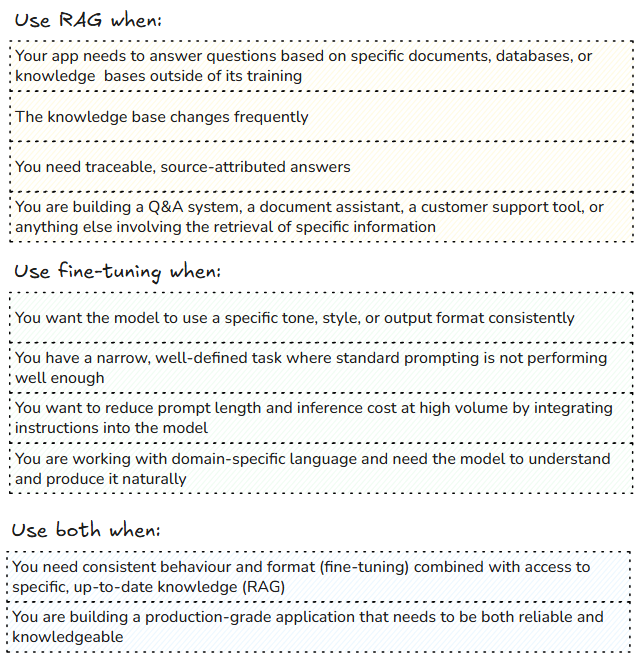
🤖 RAG and fine-tuning are not competitors: they operate at different layers of an application built with language models.
RAG, or retrieval-augmented generation, searches a knowledge base for relevant information and adds it to the prompt at query time. The model itself does not change. That makes it useful for private documents, current data, and sources the model never saw, while also enabling traceable answers.
Fine-tuning changes the model: it continues training with specific examples and adjusts its weights. It is useful for teaching a tone, an output format, a JSON structure, or a narrow task. However, it is not a reliable way to load facts that must be recalled accurately and kept current.
🎯 The practical rule is simple: fine-tune for behavior; use RAG for knowledge. A support assistant can use both: fine-tuning maintains the brand voice while RAG provides current documentation.
💡 Explanation in a nutshell#
Think of the model as a person. RAG gives it the right book before it answers; fine-tuning teaches it how to speak and organize the response. If it needs new information, give it access to documents. If it needs to behave consistently, train it with examples.
More information at the link 👇