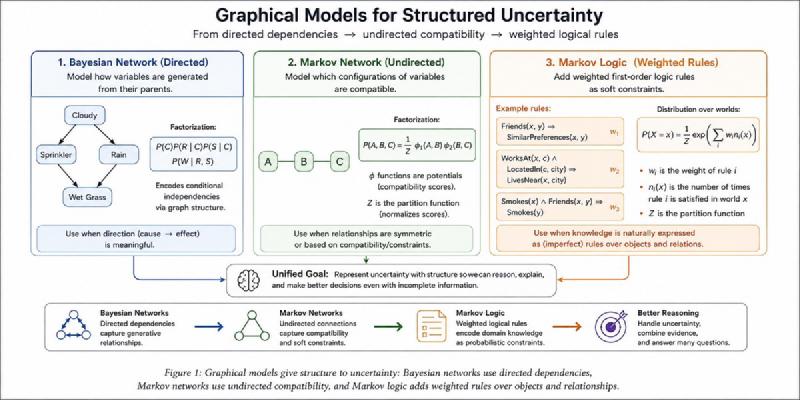
Bayesian Networks and Markov Networks: Probabilistic Models for Uncertainty 📊#
Bayesian networks and Markov networks are fundamental tools in probability and statistics that allow us to model complex relationships between uncertain variables. Unlike traditional supervised learning, which focuses on predicting a single target, these networks help us represent a small complex world where multiple variables are interrelated.
💡 Explanation in a nutshell#
Bayesian networks encode how uncertain variables depend on one another, allowing us to update beliefs when new information enters the system. Using directed graphs, they represent the joint probability distribution in a manageable way. Markov networks are similar but use undirected graphs for variables without clear cause-effect relationships.
Main applications:
- Medical diagnostics: predict diseases from symptoms
- Recommendation systems: model user preferences
- Risk analysis: understand how events influence each other
- Natural language processing: syntactic disambiguation
These networks are more flexible than traditional models for capturing uncertainty in complex systems.
More information at the link 👇