📸 The Revolution in Image Coding#
The internet runs on images. From the earliest days of the web, there has been constant tension between visual fidelity and bandwidth. For decades, JPEG was our standard, but with HDR (High Dynamic Range) displays and wide color gamuts, its limitations become evident.
Now, Google and the open-source community present JPEG XL, the new image standard that promises to revolutionize how we share visuals on the web. But its story is far more fascinating than just a new format: it’s an epic of 15 years of experimentation.
💡 Explanation in a nutshell#
JPEG XL is a new image format that compresses files much better than JPEG while maintaining better quality. Imagine being able to save a photo with the same quality in a file 50% smaller, or get the same quality as before but with a file 5 times smaller. That’s what JPEG XL achieves. Plus, it supports richer colors (HDR), meaning photos with incredible detail in lights and shadows.
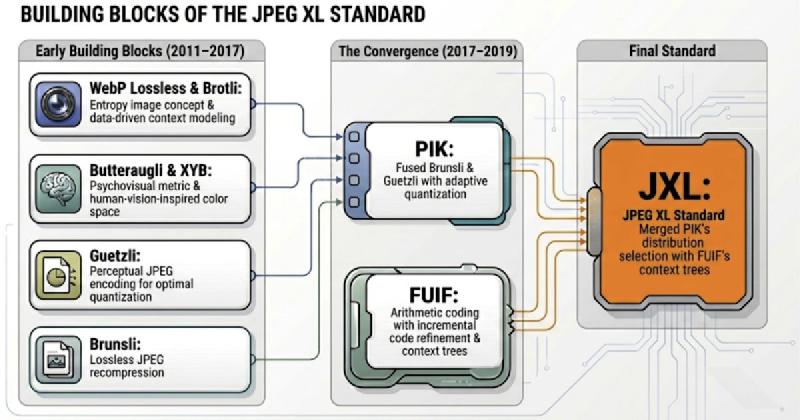
🔬 The Building Blocks (2011-2017)#
Google didn’t start trying to create a new standard. It started experimenting:
WebP Lossless & Brotli (2011)
- Pioneer in “entropy image” techniques to compress data more intelligently
- The knowledge was reused in Brotli, the modern web compressor
Butteraugli & XYB (2014)
- They discovered that compressing using pure mathematics (PSNR) didn’t work for color-rich images
- Created Butteraugli, which mimics how the human eye detects changes in images
- Developed the revolutionary XYB color space in perceptual compression
Guetzli & Brunsli (2015-2016)
- Guetzli: An incredibly slow but ultra-efficient encoder that uses Butteraugli to compress old JPEGs 20-30% more
- Brunsli: Recompresses old JPEGs without losing information (lossless)
🚀 The Convergence (2017-2019)#
By 2017, they had powerful tools. It was time to merge them:
PIK (2017)
- Combined the efficiency of Brunsli with the perceptual optimization of Guetzli
- Was Google’s proposal to the ISO standardization committee
The Union with FUIF
- PIK merged with FUIF (from Cloudinary), taking the best of both
- PIK: faster code distribution
- FUIF: sophisticated context trees
- Result: JPEG XL combines both advantages
🎯 JPEG XL Today#
The new standard is already being adopted:
- Photography: Digital Negative (DNG 1.7), Apple ProRAW
- Medicine: DICOM standard for medical images
- Publishing: Future versions of PDF and EPUB
- Operating Systems: Safari (2023), iOS, macOS, Ubuntu, Windows
More information at the link 👇