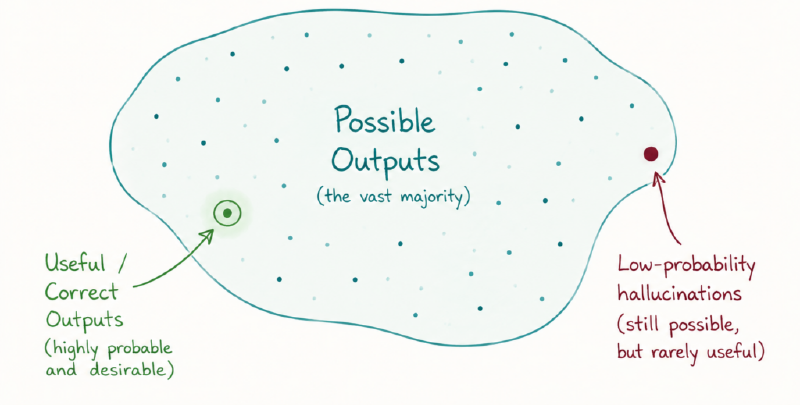
🎲 The Problem of Confusing “Possible” with “Probable” in AI Models#
An LLM can write a kernel driver. Can generate functional code. Can draft a legal policy. But does “can” mean it will consistently do it well? It turns out what is “possible” is a surprisingly low bar. 📉
🔢 The Math of the Problem#
A language model generating 512 tokens with a vocabulary of 50,000 possibilities has a sample space of 50,000⁵¹². In that ocean of possibilities, useful and correct outputs are a pond.
Hallucinations are not bugs. They are the model sampling regions of the distribution with non-zero probability but little practical value.
⚠️ 5 Concepts the Industry Confuses#
| Myth | Reality |
|---|---|
| “More data = more truth” | Converges toward dominant patterns, not toward truth |
| “Softmax = confidence” | The “confident fool problem”: amplifies small differences |
| “High temperature = creativity” | Exploring low-probability regions → more hallucinations |
| “85% accuracy = 85% reliable” | Outputs are conditional, not independent Bernoulli trials |
| “The model knows what it doesn’t know” | Most don’t model their own uncertainty |
🛠️ How to Go from Possible to Reliable#
- Platt Scaling / Isotonic Regression — calibrate confidence scores
- Bayesian Neural Networks / Monte Carlo Dropout — quantify uncertainty
- External validation — don’t assume the model will naturally follow rules
💡 Explanation in a nutshell#
This Towards Data Science article offers a deep probabilistic perspective on why LLMs fail in ways that surprise their designers. The central argument: building an AI demo is easy because demos thrive on interesting edge cases. Building a production system is hard because it requires consistency. When someone shows you an impressive AI demo, the right question isn’t “can the model do this?” but “is this what the model typically does, or is this a particularly lucky sample?”
More information at the link 👇