🏗️ The Python Data Engineering Stack in 2026: Beyond the Usual Suspects#
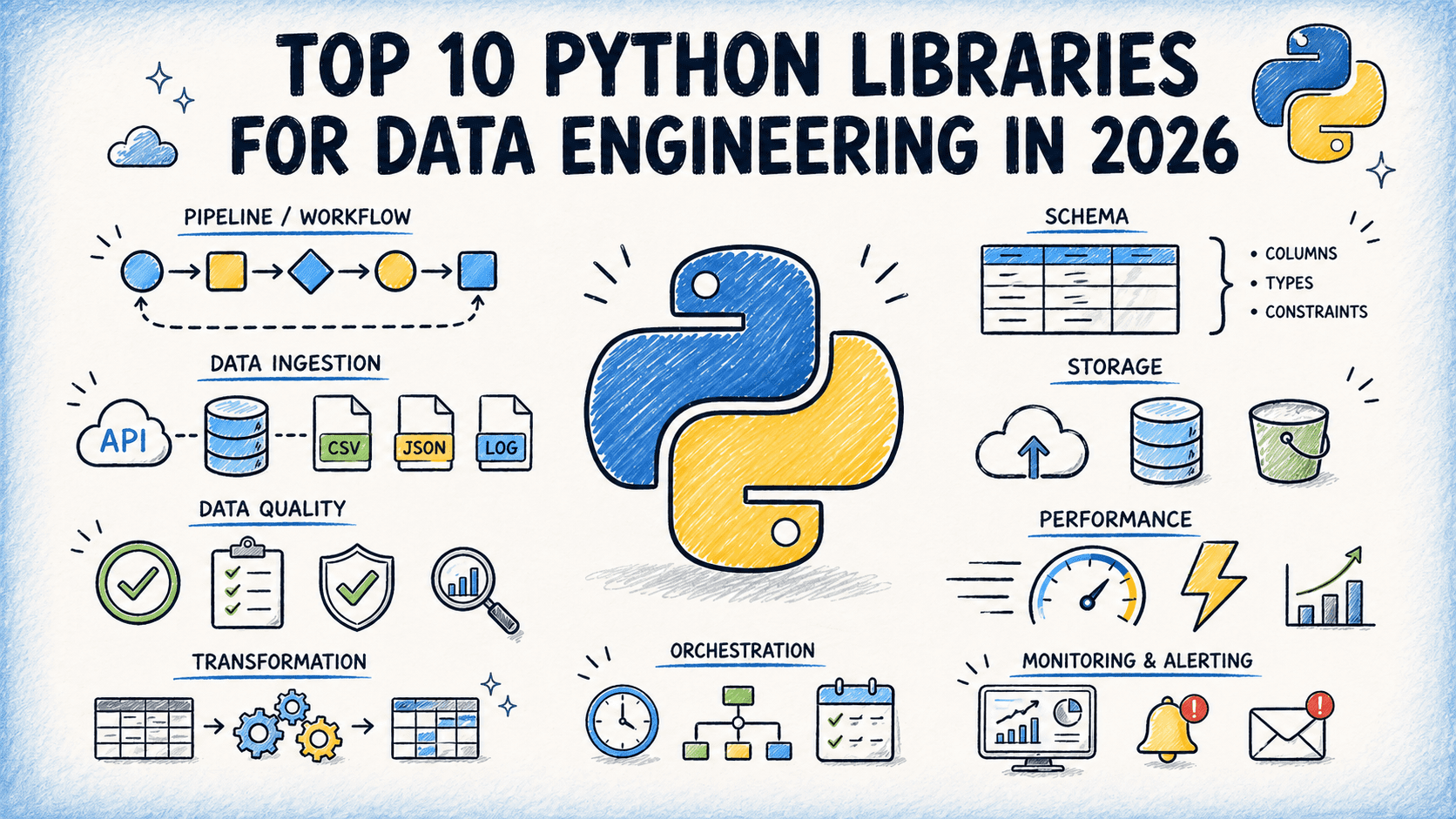
Data pipelines in 2026 need to be faster, more reliable, and easier to maintain. KDnuggets presents 10 Python libraries organized across 4 critical areas. 🐍
⚙️ Pipeline Orchestration#
| Library | Purpose |
|---|---|
| Prefect | Modern orchestration, monitoring UI, automatic retries |
| SQLMesh | SQL transformations with true CI/CD and virtual environments |
📥 Ingestion and Formats#
| Library | Purpose |
|---|---|
| dlt | Source-to-destination pipelines with minimal code, auto-schema |
| Bytewax | Python streaming, built on Rust, Kafka integration |
| PySpark | Distributed batch processing at petabyte scale |
✅ Quality and Schemas#
| Library | Purpose |
|---|---|
| Great Expectations | Human-readable expectations + data docs for stakeholders |
| Pandera | DataFrame schema validation with Python decorators |
🚀 Storage and Performance#
| Library | Purpose |
|---|---|
| DuckDB | In-process analytical SQL on Parquet/CSV without a server |
| Polars | Rust-based DataFrame, multi-threaded, pandas replacement |
| Ibis | Unified API compiling to 20+ SQL backends |
💡 Explanation in a nutshell#
The Python ecosystem for data engineering has matured significantly. Key 2026 trends: Polars replaces pandas for mid-scale ETL, DuckDB democratizes local SQL analysis, Bytewax brings native Python stream processing without needing Flink, and Ibis solves the portability problem across SQL engines. For orchestration, Prefect simplifies what Airflow complicated. This stack covers everything from small pipelines to distributed petabyte-scale processing.
More information at the link 👇
Also published on LinkedIn.