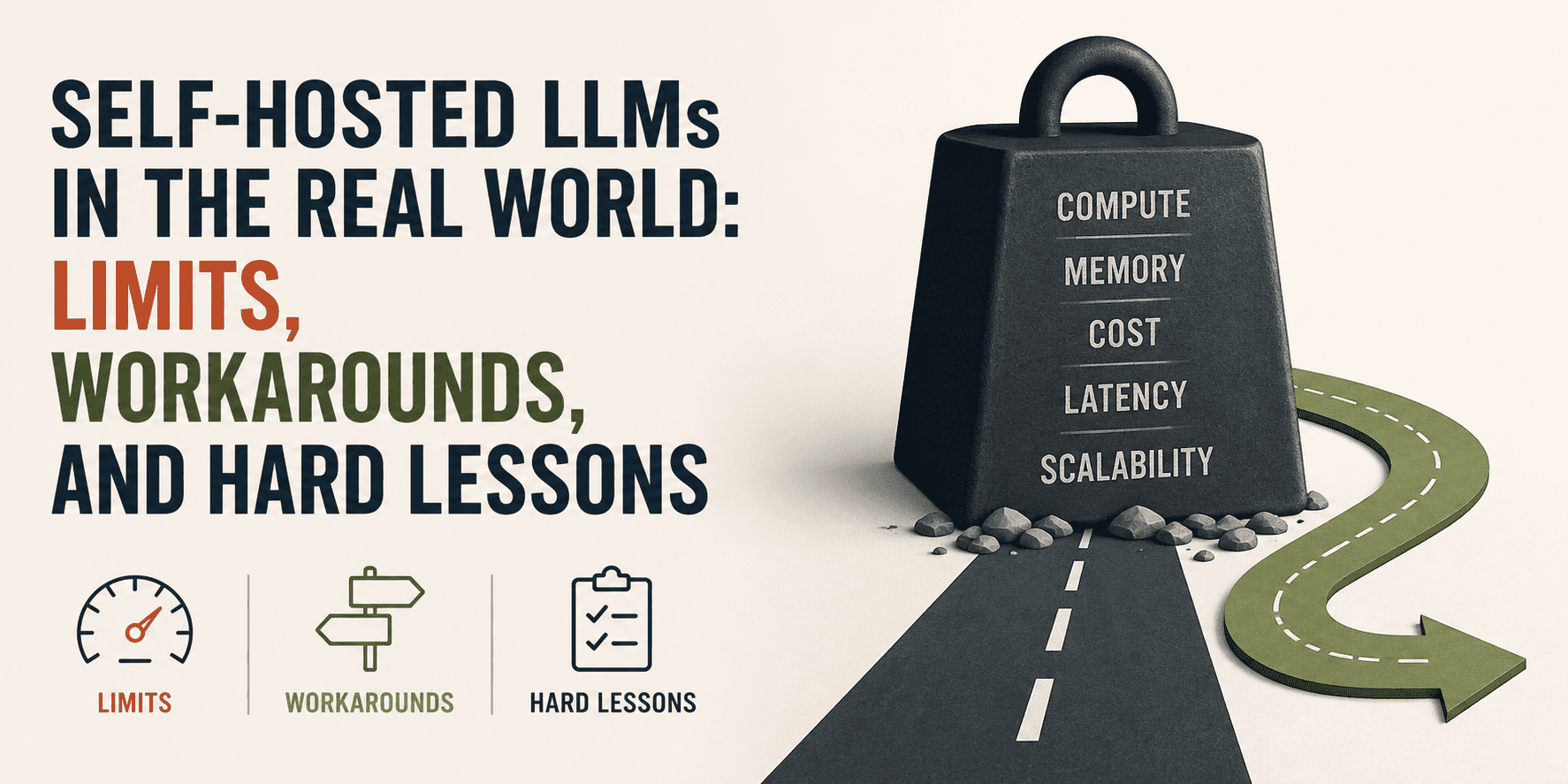
🖥️ Self-Hosting an LLM: Sounds Easy, It’s Not
“Run your own large language model” is the “just start your own business” of 2026. No API costs, no data leaving your servers… until reality shows up uninvited.
⚠️ The real problems most tutorials skip:
- 🎮 Hardware: a 7B model needs at least 16GB of VRAM. Beyond 13B or 70B, you’re looking at multi-GPU setups or quantization trade-offs.
- ⚖️ Quantization: reducing from FP16 to INT4 saves memory and speeds up inference, but degrades precision. Reasoning tasks and structured output suffer most.
- 📏 Context windows: a 4K context disappears fast in a RAG pipeline. Memory scales roughly quadratically with context length.
- ⏱️ Latency: 10–15 seconds per response slows the development loop. The honest solution: better hardware or optimized serving frameworks like vLLM or Ollama properly configured.
- 📝 Prompt templates: each model family expects its own instruction format. Using the wrong template gives confusing output — not a capability failure.
- 🔧 Fine-tuning: LoRA/QLoRA require clean data, compute, and evaluation. Data quality matters more than quantity.
💡 The bottom line: tooling has genuinely improved (Ollama, vLLM, the open-model ecosystem), but hardware costs, quantization trade-offs, and the fine-tuning curve are all real. Go in expecting to own a system that rewards patience and iteration.
💡 Explanation in a nutshell#
Self-hosting an LLM means installing and running an AI language model directly on your own computer or server, instead of using services like ChatGPT. It’s free in theory, but in practice requires powerful hardware, careful configuration, and a lot of patience. It’s not for everyone, but those who manage it have full control over their data and costs.
More information at the link 👇