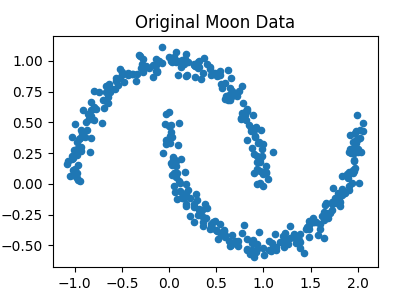
🔵 K-means fails with curved clusters. Spectral Clustering solves them using eigenvectors of the similarity graph.
The problem with K-means:
On moon-shaped data (or any non-linear structure), K-means incorrectly groups points because it assumes spherical clusters.
The Spectral Clustering workflow:
Dataset → Similarity Graph → Laplacian → Eigenvectors → Clusters
The 7 steps:
- Get data
- Similarity matrix (W) → measures similarity between each pair of points (Gaussian kernel with
gammaparameter) - Degree matrix (D) → diagonal: sum of similarities of each point with all others
- Laplacian (L = D − W) → captures the structure of the graph
- Eigendecomposition of L →
eigenvalues, eigenvectors = np.linalg.eigh(L) - Select the k smallest eigenvectors → correspond to k clusters (eigengap heuristic: pick where the largest jump occurs between successive eigenvalues)
- Apply K-means on the spectral embedding space → now clusters are linearly separable
Why it works:
The eigenvectors of the Laplacian transform data into a new space where strongly-connected points end up close together. K-means works there, even when it fails in the original space.
💡 Explanation in a nutshell#
Spectral Clustering doesn’t group by Euclidean distance but by connectivity in a similarity graph. The elegant trick: the Laplacian’s eigenvectors act as new features where complex structures become linearly separable. The combination of linear algebra + K-means allows detecting clusters that no distance-based method could find.
More information at the link 👇