🚀 pandas 3.0 introduced a change that speeds up string operations 5-10x. If you haven’t adopted it yet, here’s why.
The problem with the traditional object dtype:
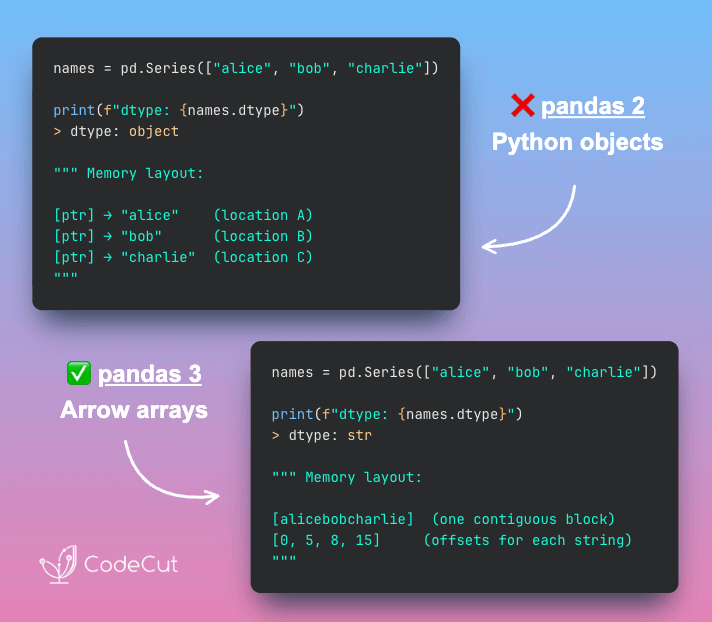
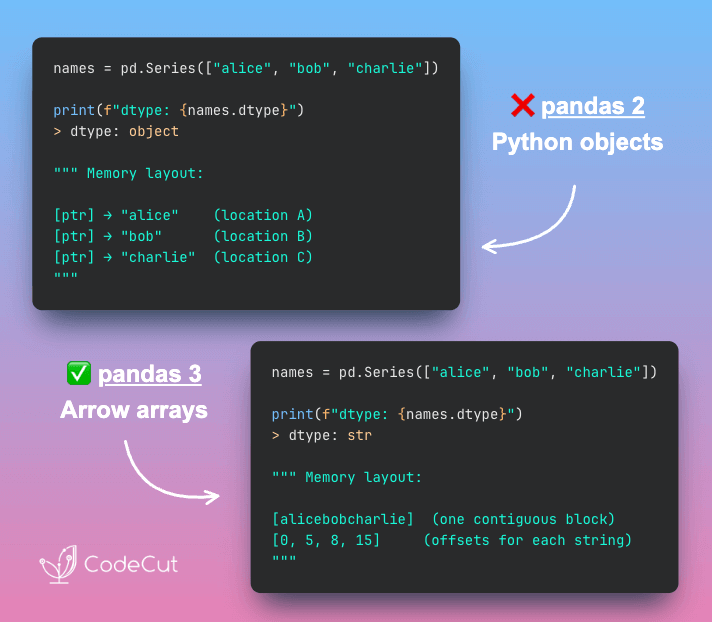
Pandas stored strings as object dtype — each string was a separate Python object scattered in memory. This caused:
- Slow operations (no memory locality)
- Ambiguity: pure string columns and mixed-type columns both showed as
object
The solution in pandas 3.0: str dtype backed by PyArrow
Stores strings in contiguous memory blocks (like columnar storage). Real results:
✅ 5-10x faster string operations (data is contiguous in memory) ✅ 50% less memory by eliminating Python object overhead ✅ Clear distinction between string columns and mixed-type columns
Also in the newsletter:
💡 Pregex — transforms regex into readable Python code using descriptive components. Instead of [a-zA-Z0-9.\_%+-]+@..., you write code that explains itself. Ideal for teams where not everyone masters regex.
💡 Explanation in a nutshell#
The switch from object to str (PyArrow-backed) in pandas 3.0 is one of those silent upgrades with major impact. If you have pipelines with heavy text processing, enabling the new dtype can give you significant performance improvement without changing your code.
More information at the link 👇