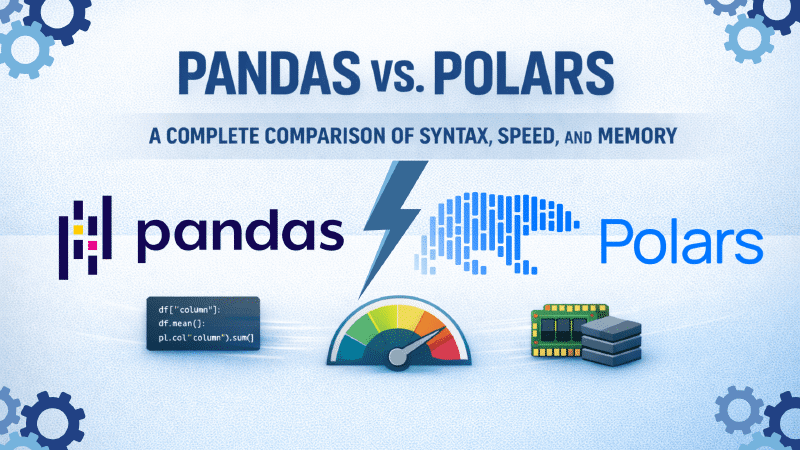
⚡ Polars reads CSVs 8x faster than pandas and uses 97% less memory. Is it worth learning?
Short answer: yes, especially for large data volumes. Concrete comparison with real benchmarks (1M rows):
Speed:
- CSV reading: pandas 1.92s vs Polars 0.23s → 8.2x faster
- Polars automatically parallelizes reading across multiple CPU cores
Memory:
- Filter + group: pandas uses 44.4 MB vs Polars 1.3 MB → 97% less memory
- Polars uses columnar storage and an optimized execution engine
Key syntax differences:
# Filter — pandas
df[df['age'] > 28]

# Filter — Polars
df.filter(pl.col('age') > 28)
Lazy evaluation (Polars’ superpower): with scan_csv() nothing executes until you call .collect(). Polars analyzes the entire query and optimizes it before running.
When to use each:
- pandas: quick exploratory analysis, small projects, Python ecosystem compatibility
- Polars: data engineering, large datasets, production pipelines that need performance
💡 Explanation in a nutshell#
Polars doesn’t replace pandas — it complements it. If your current pipeline runs slow or consumes too much RAM, Polars may be the change you need. The learning curve is gentle: the syntax is more explicit but very similar.
More information at the link 👇
Also published on LinkedIn.