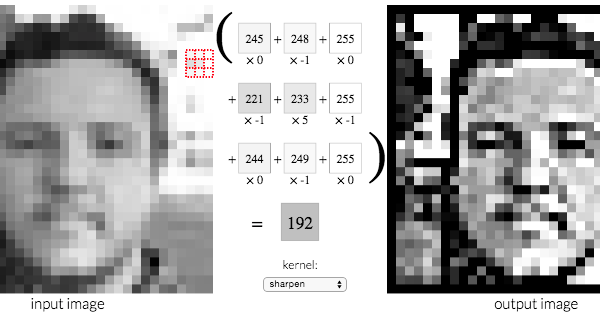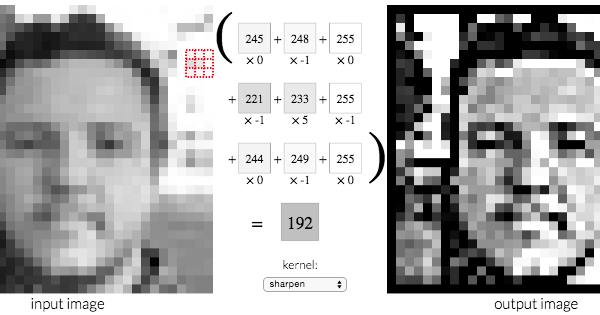
🖼️ How does a neural network actually “see” an image? The answer lies in kernels.
An image kernel is a small 3×3 matrix that slides over an image, multiplying each pixel by its values and summing the result. Depending on the numbers in the kernel, the effect changes completely:
- 🔍 Sharpen — amplifies differences between adjacent pixels
- 💧 Blur — smooths differences, reducing detail
- 📐 Outline — detects edges where intensity changes sharply
- 🌑 Emboss — simulates depth through directional gradients
This same operation is the foundation of Convolutional Neural Networks (CNNs) used in computer vision. Networks don’t “see” photos; they apply hundreds of kernels to detect patterns: edges, textures, shapes.
💡 Explanation in a nutshell#
Imagine a magnifying glass moving over an image. At each position, it multiplies nearby pixels by specific numbers and sums them. If those numbers detect edges, the lens “sees” edges; if they detect similar colors, it “sees” uniform regions. Neural networks automatically learn those numbers to detect what they need: eyes, object edges, textures.
More information at the link 👇