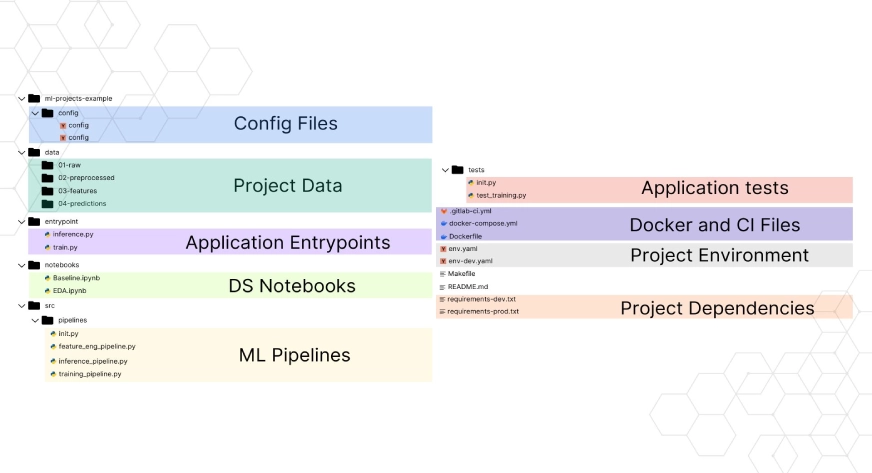
📁 Are your data science projects a mess of scattered folders and notebooks?
Organizing a project well isn’t just a nice-to-have — it’s what makes the difference between a reproducible project and one nobody (not even you) can understand six months later.
🗺️ The 4 most-used frameworks:
CRISP-DM (Cross-Industry Standard Process for Data Mining) Iterative cycle: Business Understanding → Data Understanding → Data Preparation → Modeling → Evaluation → Deployment. The most used in industry.
OSEMN (Obtain, Scrub, Explore, Model, iNterpret) Five logical steps: obtain data, clean it, explore it, model it, and interpret results.
KDD (Knowledge Discovery in Databases) Covers the full lifecycle: selection → preprocessing → transformation → data mining → interpretation.
SEMMA (Sample, Explore, Modify, Model, Assess) Model development focus: sample → explore → modify → model → assess.
⚠️ Common mistakes to avoid:
- ❌ Hardcoded absolute paths (
C:/Users/Juan/Downloads/data.csv) → ✅ Use relative paths withpathlib - ❌ Everything in a single 100+ cell notebook → ✅ Jupyter only for exploration,
.pyscripts for production - ❌ Versioning data in Git → ✅ Use DVC (Data Version Control)
- ❌ No README → ✅ Document how to install, get data, and run the project
🔍 Explanation in a nutshell
A “process framework” is simply a roadmap for your project. It tells you what to do first, what comes next, and how to evaluate progress. CRISP-DM is the most adopted in business, while OSEMN is more popular in academic tutorials. The key is to pick one and apply it consistently!
More information at the link 👇