🌊 Drift Detection in Robust Machine Learning Systems
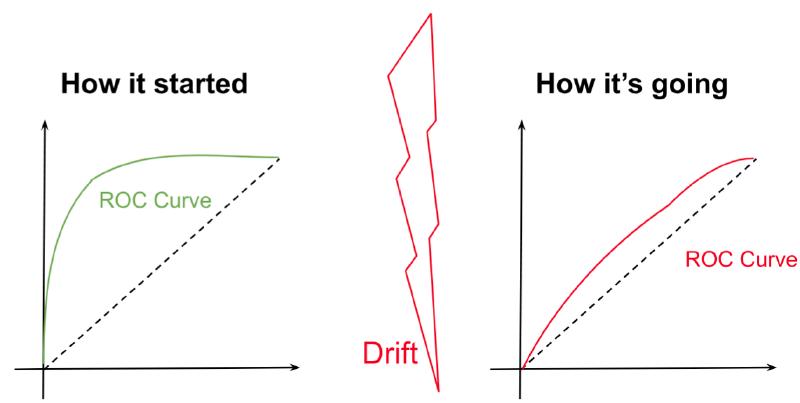
Your model works perfectly in staging. Goes to production. Six months later… it silently fails. The reason? Drift: the data changed, but the model didn’t.
📊 Two types of drift:
- 📉 Data drift: the feature distribution changes. Doesn’t always degrade the model, but it’s an early warning.
- 🎯 Concept drift: the relationship between features and target changes. Almost always degrades performance.
🔬 How to detect it:
- K-S test, PSI, Chi-Squared → univariate distribution checks
- Autoencoders → multivariate drift (when individual features don’t show it)
🛡️ How to fight it:
- Robust feature selection
- Fallback plan ready before deployment
- Retraining with continual learning
💡 Quick explanation
Imagine training a spam detection model in 2020. By 2026, spammers use entirely new techniques. Your model is still looking at past patterns. That’s drift. Early detection is the difference between a resilient system and one that fails without anyone seeing it coming.
More information at the link 👇

Also published on LinkedIn.