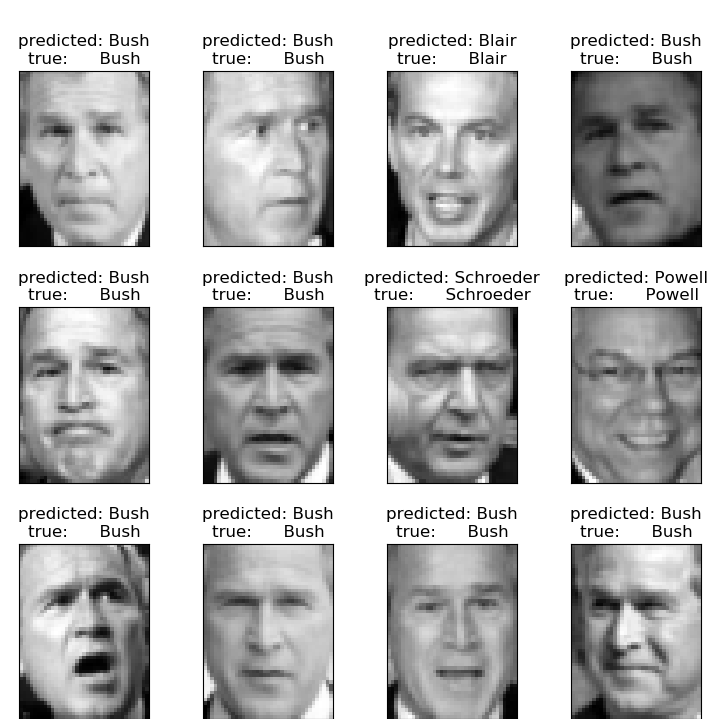
🚀 Learn Machine Learning: recognize faces#
Learning machine learning is like teaching a machine to recognize patterns.
It’s key to developing solutions that “think” with data: from recommendations to object detection.
🤖 Why start?#
- 📊 Data + 📐 Models = predictions.
- 🧠 It’s a cross‑cutting field: health, finance, art…
- 🔄 Constant practice: trial and error.
🔍 Practical example (Python)#
from sklearn.datasets import fetch_lfw_people
from sklearn.model_selection import train_test_split
from sklearn.svm import SVC
from sklearn.metrics import classification_report

# load face images (famous people)
faces = fetch_lfw_people(min_faces_per_person=20, resize=0.4)
X = faces.data          # pixels
y = faces.target        # labels

# split into train and test
generated = train_test_split(X, y, random_state=42)
X_train, X_test, y_train, y_test = generated

model = SVC(kernel='rbf', gamma='scale')
model.fit(X_train, y_train)
pred = model.predict(X_test)

print(classification_report(y_test, pred, target_names=faces.target_names))
📝 Face detection in images#
Detecting faces is a basic task in computer vision.
It’s used in 🔐 security, 📱 social apps and much more.
OpenCV has pre-trained classifiers that let you find faces easily; just tweak parameters and filter with techniques like edge detection.
🧩 Explained in a few words#
Imagine you give the computer lots of photos and tell it “here is a face.”
With those examples, the program learns what faces look like (eyes, nose, mouth…) using math behind the scenes.
Then, when you show a new image, it can say whether there’s a face and where it is.
It’s like teaching a friend to recognize your colleagues: first you show them photos, then they can find them on their own.
💡 Learning ML comes down to curiosity and practice. Start today, play with data, and you’ll see yourself evolve!
More information at the link 👇