TL;DR#
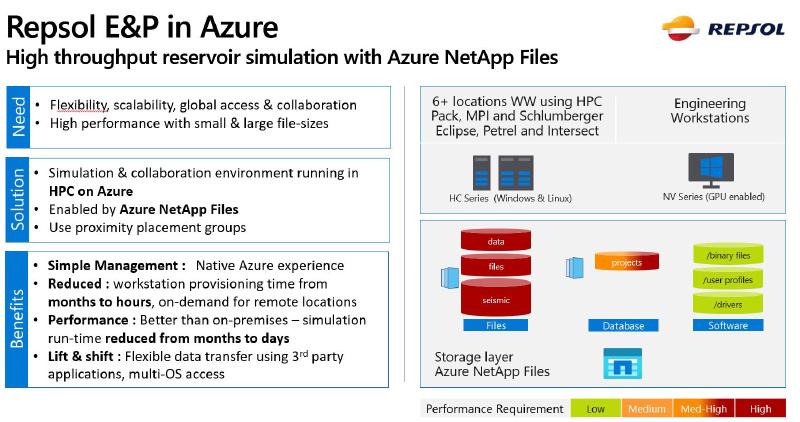
Repsol moved reservoir simulation —one of the most compute-intensive processes in the industry— to Azure, scaling from hundreds to thousands of compute cores. Result: simulations that used to take 30 days now complete overnight, democratizing access to HPC for geoscientists around the world. 🌍⚡
Participation in Microsoft Ignite#
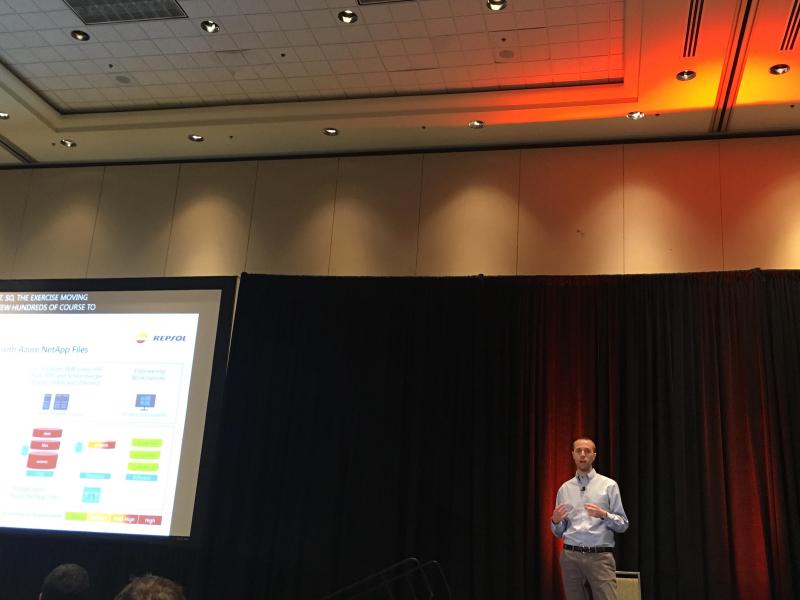
In November 2019, I took part in Microsoft Ignite, presenting the work we carried out at Repsol to scale our simulation on Microsoft Azure using technology from NetApp and NVIDIA.
🛢️ Who is Repsol?#
Repsol is a global energy company, present in 35 countries, headquartered in Madrid. It operates across the entire energy value chain and is a leader in technological innovation applied to the subsurface.
🧠 What is reservoir simulation?#
Reservoir simulation is a key discipline in geosciences and oil & gas:
- 🧮 Models billions of cells
- 🪨 Each cell contains rock and fluid properties
- 🌊 It simulates fluid dynamics in the subsurface
- 💻 Requires CPU, GPU and storage at large scale
- 📦 Each simulation can produce several GB per hour
🏗️ What did we have before?#
The traditional architecture was based on:
- 🖥️ On-premise clusters of ~200 physical cores
- ⏳ Long compute times
- 🔒 Limited access dependent on local infrastructure
🎯 What did we want to achieve?#
A simple but powerful question:
What if every Repsol engineer, in any office in the world, had access to the same compute capacity?
To achieve this:
- 📈 We scaled from hundreds to thousands of cores
- ☁️ Deployed HPC on Azure
- 🌍 Two active regions: Amsterdam and Austin
- ⚙️ Automated provisioning with Azure Resource Manager
- ⏱️ Machines ready in hours, no procurement delays
✅ Key benefits#
- 🧑🤝🧑 Democratization of technology
- 🚀 Performance improvements by orders of magnitude
- 🧘♂️ More comfortable and productive environments for geoscientists
- 🔁 Repeatability, scalability and speed
📖 A real story#
An engineer runs an uncertainty analysis that historically took almost 30 days.
- 🌆 Launches the simulation in the evening
- 🌅 The next morning… the process had stopped
- 📞 About to request support
- 😲 Finds out: everything had finished
👉 One month of compute, reduced to a single night.
🧩 Technology behind the scenes#
🛠️ Lift & shift of leading software:
- Schlumberger Eclipse and Petrel
- Emerson Paradigm (multi-OS)
📂 Data transfer with Azure NetApp Files
🧠 Decades of on-premise experience at Repsol
🤝 Implemented in months, thanks to collaboration between:
- Repsol
- Microsoft
- Azure NetApp Files
🖥️ How does it work? (Architecture)#
- 📊 Results are analyzed on virtual workstations in Azure (the NV family, with GPU)
- 💾 Direct access to terabytes of data
- 🌐 The geoscientist connects via Mechdyne TGX
- 💻 They only need a light local machine, from anywhere in the world
🧠 Explanation in short#
Imagine that before there was only one supercomputer in one office, and everyone had to take turns.
Now, thanks to the cloud, each engineer has access to their own supercomputer, no matter where they are 🌍.
That enables faster work, more scenarios to test, and better decisions.
💬 The cloud isn’t just moving servers: it’s changing the way science and engineering work.
The following video shows the case 👇
Satya Nadella (CEO of Microsoft) and George Kurian (CEO of NetApp) highlighting this project 👇
More about this project 👇